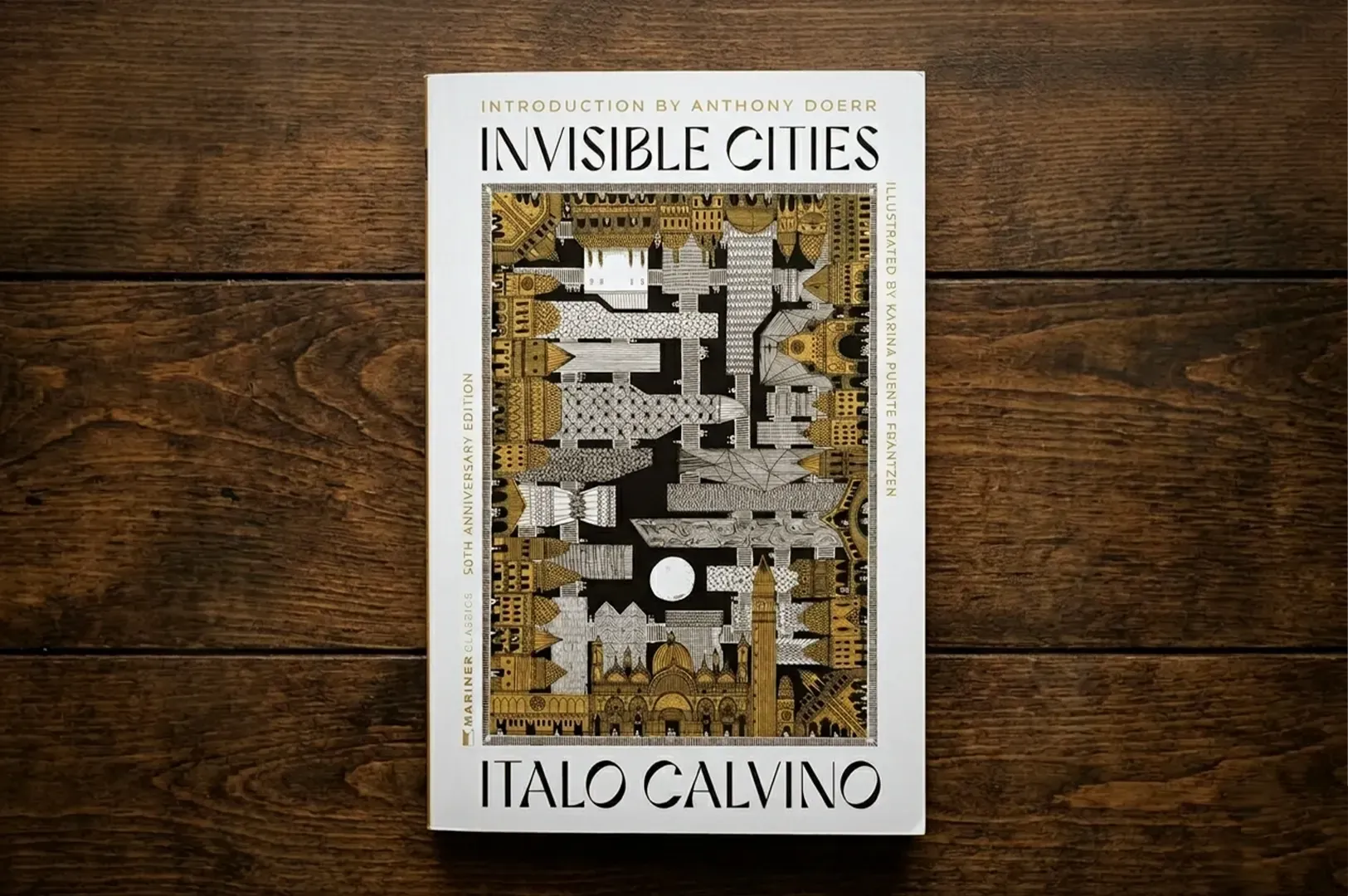
Invisible Cities by Italo Calvino | My Quiet Empire Book Review
Bay San
There is a line in Invisible Cities that feels like a key left quietly on the table: “Cities, like dreams, are made of desires and fears.” It is one of those sentences that seems simple until it begins rearranging the room around it. Calvino does not describe cities as a realist might, with traffic, weather, infrastructure, and municipal fact. He gives us cities made of longing, memory, signs, rituals, and vanishing impressions. Somehow, because of that, they feel more accurate.
I return to Invisible Cities when I need to remember that imagination is not an escape from truth. Sometimes it is the sharper instrument. Realism can show us what a place contains. Calvino shows us what a place reveals.
The book’s premise is famously spare: Marco Polo describes impossible cities to Kublai Khan. But to read it for plot is to miss its quiet intelligence. The real movement is inward. Each city becomes less a destination than a mirror. We begin to sense that every place is shaped not only by streets and walls, but by the person looking at it. One city is memory. Another is desire. Another is fear arranged into architecture. Another is a system of signs that replaces the thing itself.
This is what makes the book feel so strangely intimate. Calvino is not really asking, “What is a city?” He is asking, “What do you see when you look at the world, and what does that reveal about you?”
That question matters beyond literature. In entrepreneurship, leadership, and institution-building, the visible structure is never the whole structure. A company has offices, documents, meetings, pricing, menus, policies, and rituals. But beneath those things are invisible forces: values, attention, tolerance, standards, fear, ambition, taste. Over time, the invisible becomes visible. It shows up in how people greet one another, how decisions are made, how mistakes are handled, how quality is protected when no one is watching.

This is where Invisible Cities feels unexpectedly practical to me. Calvino understands that worlds are built through repetition and variation. The book’s structure is almost catalog-like, with short entries grouped around recurring themes. At first, this can feel delicate, even elusive. But the repetition is not decorative. It is discipline. Each city is a variation on a hidden question. Each return creates rhythm. Each constraint makes the imagination more precise.
That is a useful lesson for anyone trying to build something meant to last. Freedom alone rarely produces meaning. Meaning often comes from chosen limits: the recurring meeting, the training ritual, the standard that survives growth, the detail repeated until it becomes culture. Calvino’s cities dissolve as soon as we try to hold them too tightly, yet the architecture of the book is remarkably firm. Dream and structure are not opposites here. They depend on each other.
My honest critique is that Invisible Cities can feel distant if approached with the wrong expectation. It does not offer the warmth of character development or the satisfaction of narrative momentum. Its brilliance is cool, crystalline, sometimes almost too composed. On certain days, that elusiveness can feel like a barrier. On better days, it feels like the point. Calvino leaves space because the reader must enter and complete the city.
His craft is extraordinary because it is so compressed. The language is clear without being plain, philosophical without becoming heavy. He turns ideas into scenes, and scenes into instruments of thought. Few books make abstraction feel so physical.

Invisible Cities is not a novel I read for escape. I read it to sharpen perception. It reminds me that every empire, business, home, and life is partly made of what can be measured, and partly made of what cannot. The visible city is never only the city. It is the memory inside it, the desire beneath it, and the discipline that gives it shape.