

In Praise of Shadows by Jun'ichirō Tanizaki | My Quiet Empire Book Review

Bay San

Bay San

The book had been sitting on my shelf for years. I finally opened it after a long evening at the omakase counter, where I had watched a lacquer bowl catch the low light. The gold inside it did not gleam. It smoldered. You had to lean in to see it, and leaning in was the whole point.


That bowl is the book, really. Tanizaki spends his pages defending exactly that kind of beauty, the kind that only shows itself in dim rooms and asks for your patience.


Tanizaki's argument sounds small at first. He is writing, in part, about a toilet. About lacquerware. About the way soup looks in a dark bowl versus a bright one. But underneath the domestic detail is something larger. He mourns what electric light did to a certain kind of atmosphere. Brightness, he suggests, flattens things. It reveals everything at once and leaves nothing to be discovered.


There is a line I keep returning to, which I will paraphrase since I do not have it exactly: we find beauty not in the thing itself, but in the pattern of shadows the thing creates, in the play between light and darkness that one thing produces against another.


I read that twice. It named something I had been chasing in my work without a word for it.

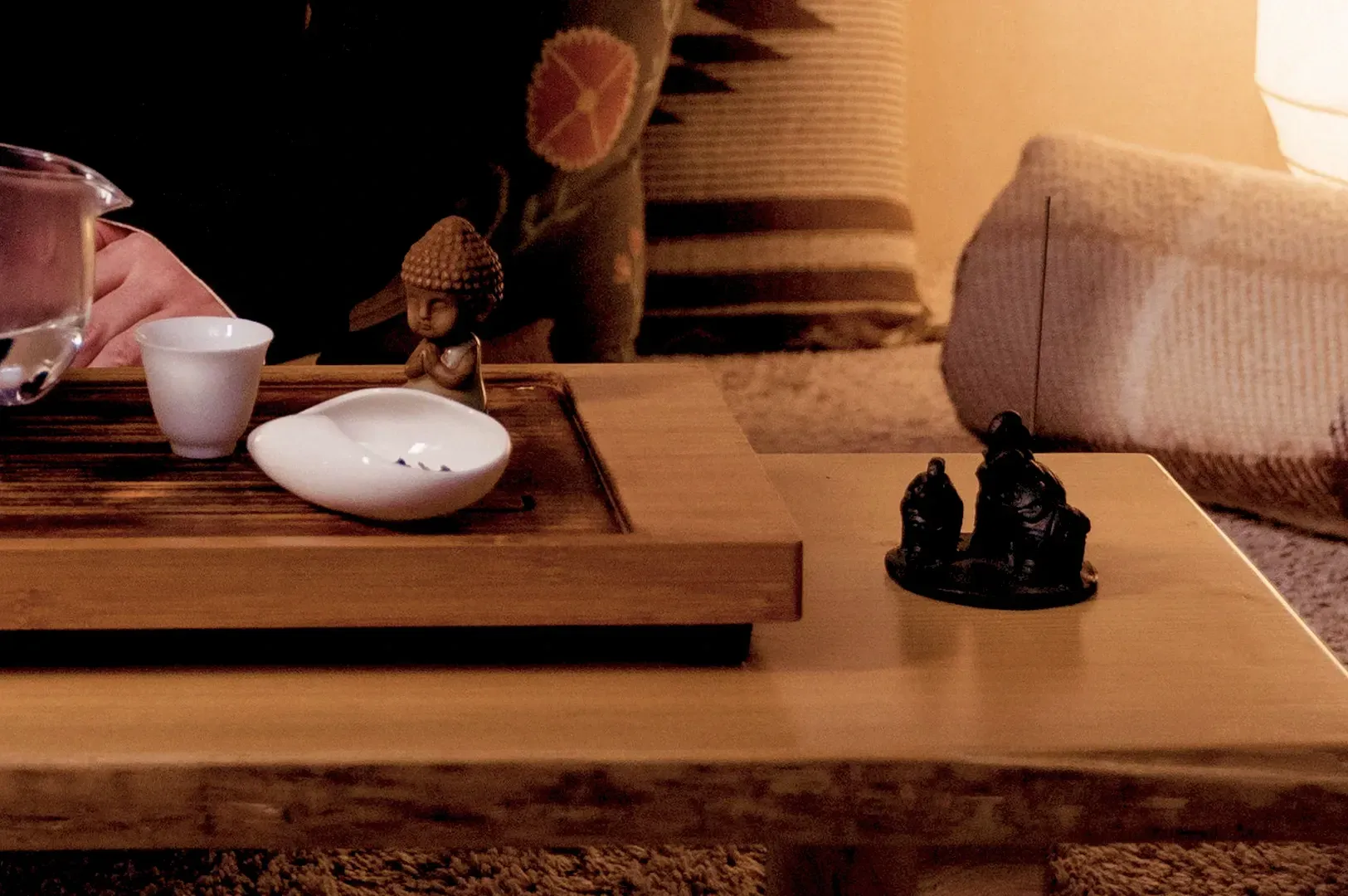
A tranquil tea ceremony setting featuring dim, warm lighting that emphasizes the beauty of restraint and atmospheric shadows, inspired by themes in In Praise of Shadows.

For years I believed a good space was a fully lit one. Show the materials. Show the craft. Make sure the guest can see everything they are paying for. Then, in the early days of the tea room, we made a mistake that turned into a lesson. The overhead lighting we had chosen was too bright. It exposed every seam, every scuff on the old wood. The room looked honest but felt like a waiting area.


We dimmed it. We let the corners go dark. We put a single warm lamp near each table and let the ceiling disappear. Nothing about the room had changed except what we could see of it. But people started staying longer. They lowered their voices without being asked. The patina on the tables, the small imperfections I had been embarrassed by, became texture instead of flaw.


Restraint did the work. Not addition. Subtraction.

Interior view of a traditional Japanese room with sliding shoji doors, where soft, diffused light and subtle shadows create the depth and patina central to Tanizaki's aesthetic philosophy.

I did not know I was practicing intergenerational thinking. I thought I was just being stubborn about standards. Krznaric would say those are closer to the same thing than I realized. Here is my honest hesitation. The book is stronger on the case for long-term thinking than on the mechanics of it inside real institutions, where next month's payroll is not optional. Cathedral time is a beautiful idea. But cathedrals were funded by systems most of us do not have, and the tension between staying solvent now and stewarding later is not something a change in mindset alone resolves.


I finished the book convinced of the why. I am still working out the how, and I suspect that work never fully ends. This one is for the builder who has started to feel the weight of what outlasts them. The founder thinking about what they are leaving in the walls, in the training, in the people who will carry the work forward without ever knowing whose decision shaped it.


It will not hand you a system. It will change the horizon you measure against, which is quieter and, in the end, more useful.

More Book Reviews

The book cover of
By Bay San July 15, 2026
Roman Krznaric reframes legacy as cathedral time: building for people you will never meet, and the quiet discipline of the long view.

A close-up, high-angle shot of the book A Field Guide to Getting Lost by Rebecca Solnit, centered on
By Bay San July 3, 2026
Rebecca Solnit reframes getting lost as a discipline: a return to humility, attention, and the kind of not-knowing that remakes you.
A copy of 'On Dialogue' by David Bohm resting on a dark surface, representing the foundational conce
By Bay San June 25, 2026
Why genuine dialogue is rare: a reflection on Bohm's idea of thinking together, suspension, and what real listening demands of leaders and teams.
A close-up shot of the book cover
By J.C. Yue June 19, 2026
A reflection on Craeft and what craft teaches about mastery, maintenance, and building enduring value in business and life.
The book of 'Turn the Ship Around! A True Story of Turning Followers into Leaders' by former nuclear
By Bay San June 12, 2026
Marquet's lesson isn't "be nicer"—it's build leaders everywhere. A reflection on intent, ownership, and quiet mastery in teams.
A flat-lay photograph of the 50th-anniversary edition of Invisible Cities by Italo Calvino, resting
By Bay San June 5, 2026
Calvino’s Invisible Cities shows how places are built from desire and memory, an elegant lesson in craft, perception, and quiet power.
Top-down flat lay shot of “Solitude: A Return to the Self by Anthony Storr” book on a wooden table,
By Bay San May 29, 2026
Anthony Storr reframes solitude as strength: the quiet discipline that forms identity, fuels craft, and steadies builders in a noisy world.
Flat lay overhead shot of “A Life Less Throwaway” by Tara Button on a white wooden surface, minimali
By Bay San May 22, 2026
Meta Description: Tara Button argues for repair over replace. A reflection on durability as discipline, and what it means to build a life that lasts.
Top-down flat lay shot of
By Bay San May 15, 2026
Discover how James Kerr's Legacy reveals the uncompromising principles behind enduring culture, proving that standards and humility always outlast hype.
Wall‑mounted copy of “The Great Good Place” by Ray Oldenburg displayed against a minimalist white wa
By Bay San May 8, 2026
Culture is engineered, not declared. Discover how Ray Oldenburg’s exploration of third places shapes our understanding of community, belonging, and business.
Show More