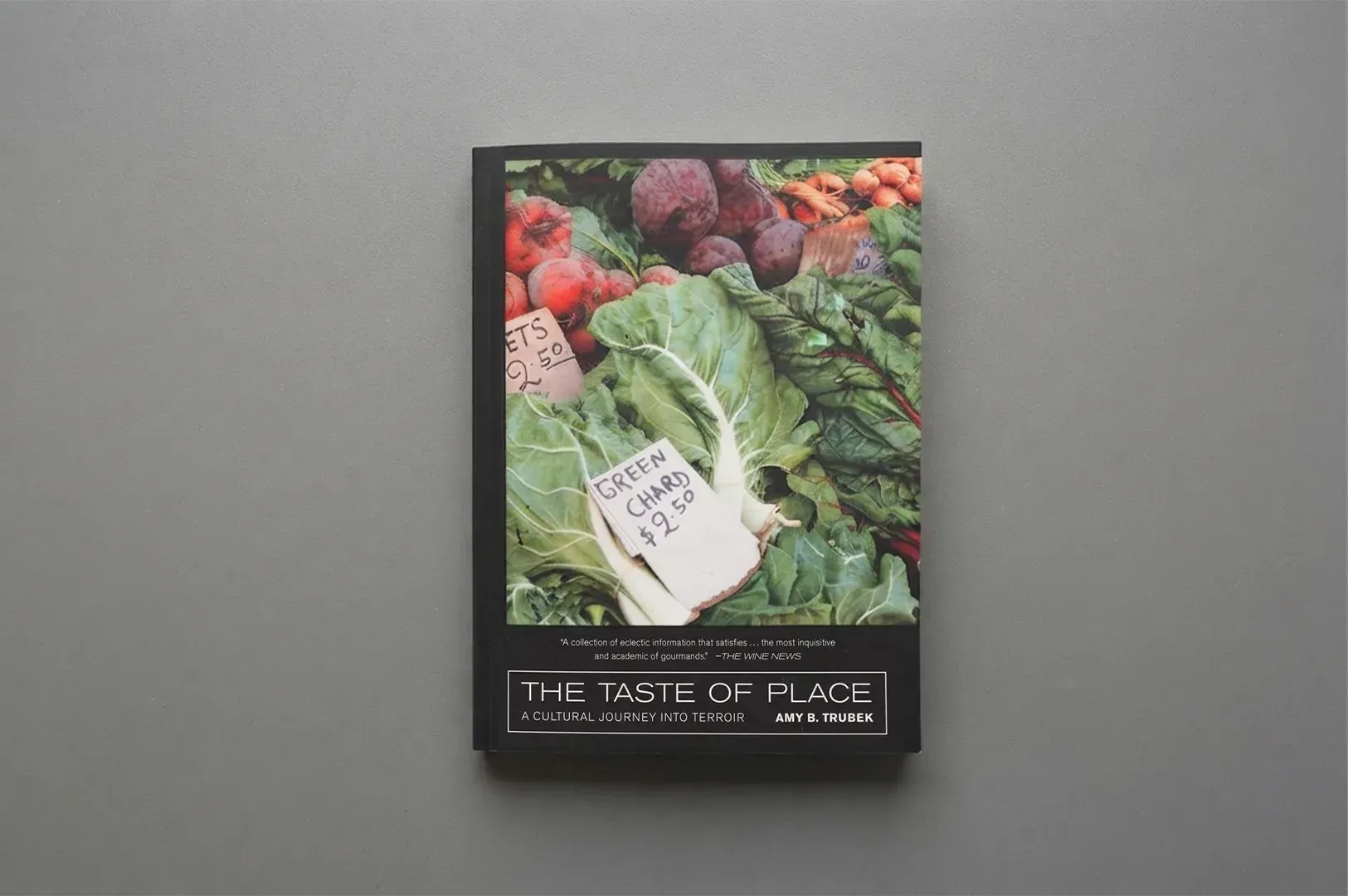
The Taste of Place by Amy B. Trubek: What Belongs to a Place | My Quiet Empire Book Review
Bay San
I picked up The Taste of Place after a conversation with a supplier who could not explain why his tomatoes tasted the way they did.
He kept pointing at the hillside, the water, the particular slope his grandfather had planted. He was not being poetic. He simply had no other language for it. Trubek gave me that language, and it turned out to be a language about far more than food.
Most people hear terroir and think of dirt and climate. Trubek complicates that gently.
Her argument, as I read it, is that place expresses itself as much through human choices as through geology. A region's taste is the sum of countless small decisions passed down over generations: what to grow, when to harvest, how to age, what to leave alone. Terroir is a conversation between land and people, not a property of the land itself.
She writes, in a line I keep returning to, about the "taste of place" as something cultivated rather than found. That word, cultivated, did a lot of work for me. It meant the flavor was not an accident of geography. It was a practice.

The idea that stayed with me longest is that taste carries culture, and culture carries memory.
When you eat something truly of a place, you are tasting decades of accumulated knowledge you cannot see. The invisible value sits underneath the visible one. This is why a dish made the old way, in the place it came from, feels different even when a technically superior version exists elsewhere.
I have felt this in hospitality more times than I can count. Years ago I watched a young cook try to reproduce a regional dish from a recipe alone. Every measurement was correct. It still tasted like nothing. What was missing was not on the page. It was the hundred small corrections a grandmother would have made without thinking, the knowledge that lived in her hands and nowhere else.
Here is where the book quietly rewards a builder. Trubek shows how limitation, seasonality, locality, the refusal to source from everywhere, produces higher standards rather than lower ones. When you cannot have everything, you learn to do a few things properly. Constraint sharpens attention.

This is the institution-building lesson I took from it. The hardest thing about scale is that it tempts you to strip away origin in the name of consistency. You standardize, you source globally, you make the thing repeatable, and somewhere in that process the soul leaks out. What preserves craft at scale is not a bigger supply chain. It is a stubborn set of constraints you refuse to relax, and people trained to notice when they slip.
I will be honest about one tension. The book is stronger on why place matters than on how "place" gets performed once it becomes a selling point. In our own era, terroir is a marketing word as often as a real one. Trubek touches this, but I wanted her to press harder on the gap between place that is genuine and place that is merely staged.
This one is for builders, chefs, brand people, anyone trying to protect quality against the flattening pull of scale. Not for a reader wanting recipes.
It left me with a question I still carry into every venture. What in my work actually belongs to a place, and what have I quietly made placeless without noticing?