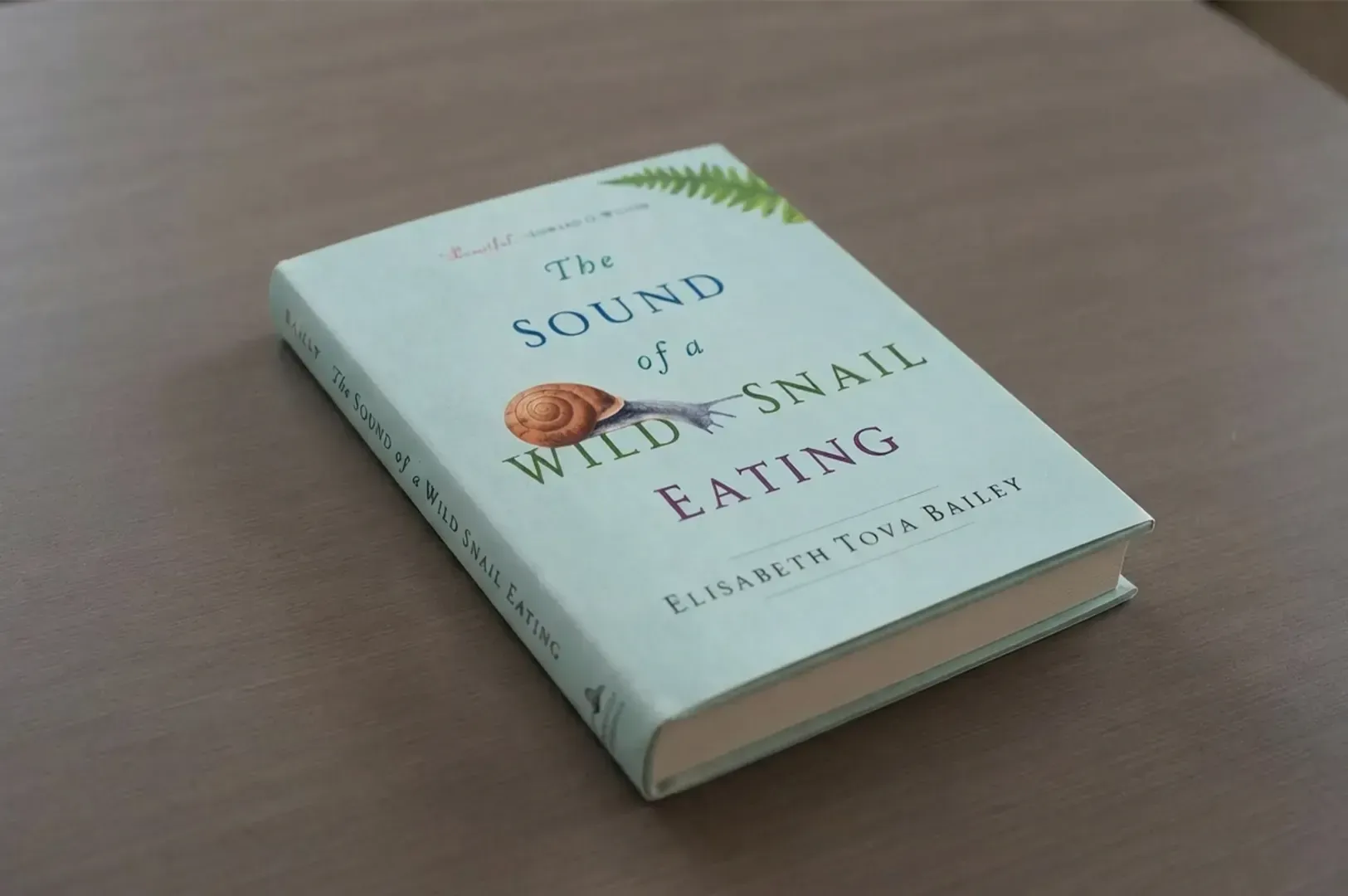

The Sound of a Wild Snail Eating by Elisabeth Tova Bailey | My Quiet Empire Book Review
Bay San
I did not pick up this book for comfort. I picked it up because someone I respect told me it had changed how she listened. That is a strange thing to say about a book. I understand it now.
The premise is almost too simple to trust. A woman, bedridden by illness, is given a wild snail in a pot of violets. She cannot move much. So she watches the snail. That is the book.
I expected to be bored. Instead I found myself slowing to its pace, and then, without quite noticing, keeping it.
There is a moment early on when she first hears it. The snail, eating. A tiny, distinct sound in the quiet of a sickroom. She describes it as the smallest of noises, and she stops everything to attend to it. I read that passage twice. Then I set the book down and sat with the fact that I had not heard anything that small in years.
She writes, and I am paraphrasing here, that the snail lived at a pace her illness had forced upon her, and that watching it taught her to inhabit her own slowness rather than fight it.
That line stayed with me. I have spent decades building things that reward speed. The next opening, the next season, the next room to stand up. Momentum becomes a kind of religion. You stop asking whether you are moving toward anything or simply moving.
The snail does not have that problem. It moves when the conditions are right and rests when they are not. Nothing about it is wasted.

Here is the connection I could not shake. The businesses of mine that lasted were never the ones I forced. They were the ones I paced. The kitchen that took a year to get its rice right. The teaching practice that grew one honest relationship at a time. Force gets you a quarter. Pacing gets you a decade.
Bailey's snail is a small system doing exactly what it needs and no more. Watching it, I recognized something I had learned the hard way. You cannot push a thing into resilience. You can only tend it, patiently, and let it hold at its own rate.
Attention, it turns out, is the quiet form of that tending. She could do nothing for the snail but notice it fully. And her full noticing was enough to keep her, in her worst season, whole.
I will be honest about my hesitation. There is a stillness in this book that occasionally tips toward the airless. Bailey's world is so narrowed, so hushed, that I sometimes wanted a window thrown open. Illness gave her this attention without her choosing it. I am not sure the rest of us can borrow the lesson without borrowing the loss that taught it.
That is the tension. The book makes a case for slowness, but it was slowness imposed, not chosen. Most of us have to choose it against every incentive we live inside. That is harder than the book quite admits.
This one is for the people who suspect they have stopped hearing the small sounds. The builders who have mistaken speed for progress for so long that they no longer feel the difference.
I closed it on a quiet evening and did not reach for my phone for a while. That, more than any argument in it, was the book working on me.
Some things you build by pushing. Most things worth keeping, you build by paying attention.