A Field Guide to Getting Lost by Rebecca Solnit | My Quiet Empire Book Review
Bay San
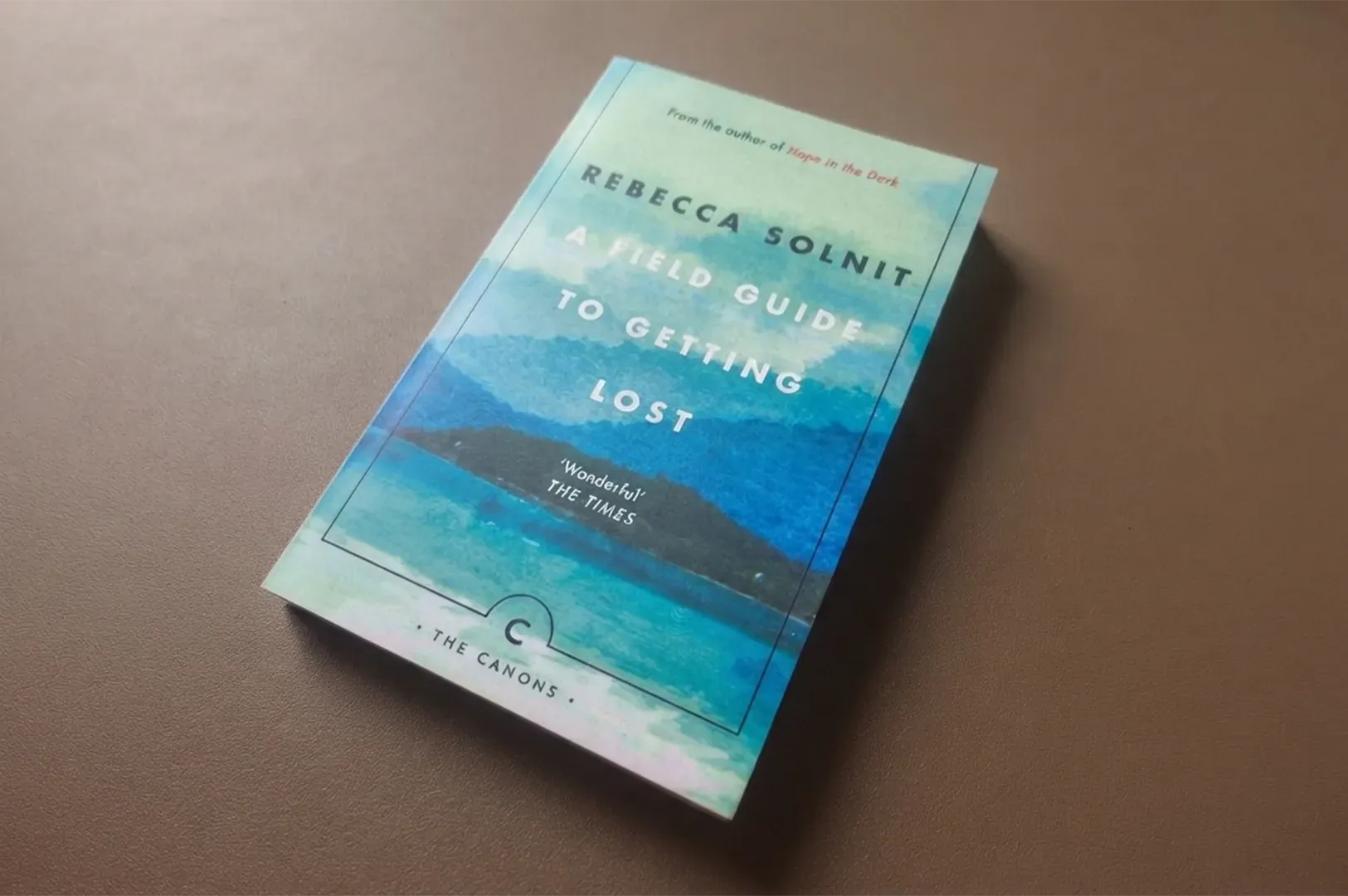
I picked up A Field Guide to Getting Lost during a season when I had run out of answers but was still behaving as if I hadn’t. I wanted a map. What Rebecca Solnit offered instead was permission to set the map down.
The book is not a guide in any conventional sense, despite its title. It moves as a series of meditations (loosely connected, unhurried, and deliberately unanchored) on loss, memory, perception, and the unknown. Solnit drifts between landscape and autobiography, art and history, anecdote and philosophy, never fully settling in one place. That refusal to settle is not a stylistic choice alone; it is the argument itself.

At one point she writes about the color blue, the blue of distance, the way mountains fade into it when they recede. “Blue is the color of longing for the distances you never arrive in,” she writes. I read that line on a train and looked up, as if the landscape outside might confirm it. It did. The sentence gave language to something I had carried for years without naming: the way desire is often tied not to arrival, but to what remains unreachable. And how arrival, when it finally happens, often dissolves the intensity that made it worth wanting.
This is one of Solnit’s quiet gifts. She takes experiences that feel private, even inarticulate, and reveals them as shared structures of perception. A feeling you assumed was personal turns out to have a geography, a color, a history.
Her central move in the book is to disentangle two states we routinely confuse: being lost and being adrift. Adrift is passive, something that happens to you without consent. Being lost, in Solnit’s framing, can be something else entirely. It can be a practice, even a discipline; the willingness to remain in a space where orientation has not yet returned, and where certainty is no longer the guiding principle.
She writes, implicitly and sometimes explicitly, about losing yourself not in panic but in surrender: the way one loses oneself in a long walk, in good work, or in attention so deep that the self becomes less rigid. The point is not immediate recovery. The point is transformation while you are still without a fixed direction.

For much of my working life, I resisted this. I treated certainty as competence. I was the person with the plan, the contingency, the answer prepared before the question had fully formed. Then something I had built began to fall apart; not abruptly, but in the slow way systems do when they are no longer aligned with reality. I tried to force clarity through effort, through analysis, through speed. None of it worked.
The shift came only when I stopped insisting on resolution. I walked more. I let a period of not knowing remain uncorrected. I stopped treating uncertainty as an error to be fixed. And in that space, something quieter emerged. Not a revelation, not a plan, but a direction that could not have been produced through force. Solnit would call this discipline: the deliberate practice of not knowing long enough for something truer to appear.
There are ways to cultivate this, though none of them feel efficient. Walk without a destination. Leave a stretch of time unstructured. Let a question remain unanswered without rushing it toward usefulness. Resist the urge to turn ambiguity into a project. None of this feels productive in the conventional sense. That discomfort is precisely the point.

This is not a book of instructions. It is a book that loosens your grip. It is for those standing at the edge of transitions they cannot yet name, and for anyone who has begun to suspect that clarity is not always the beginning of wisdom.
What Solnit offers is not direction, but a different relationship to disorientation itself. By the end, you do not feel more certain. You feel less compelled to demand certainty at every turn. And that, in its own quiet way, is a form of freedom.