

The Great Good Place by Ray Oldenburg | My Quiet Empire Book Review

Bay San

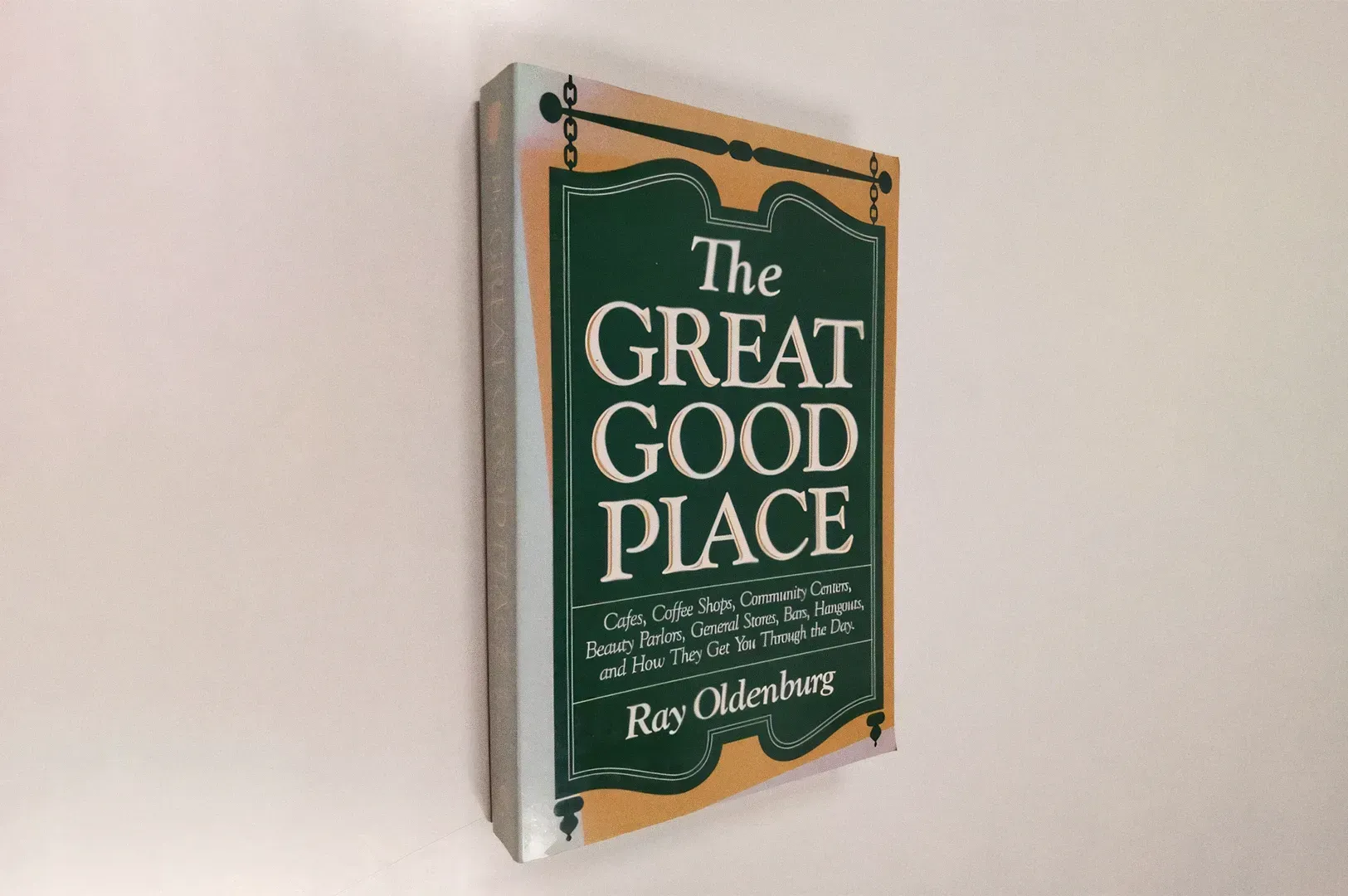
In my experience building businesses and brick-and-mortar communities, I have learned a quiet but absolute truth. Culture is never an abstract value painted on a boardroom wall. It is an engineering problem. It is shaped by the physical environments we construct, the informal rituals we encourage, and the daily standards we quietly enforce. I turned to Ray Oldenburg’s The Great Good Place because it provides a foundational blueprint for this exact kind of spatial engineering.


Oldenburg famously coined the term "third place" to describe the informal public gathering spaces that exist outside of the home (the first place) and the workplace (the second place). These are the local cafes, neighborhood bookstores, and taverns that act as the living rooms of a functioning society.

Bustling Paris street café with red awnings and outdoor seating, people gathered at small tables along the sidewalk, photographed from a street‑level wide angle, illustrating urban café culture and social “third places.”

One line from Oldenburg perfectly captures the specific magic of these environments: "The character of a third place is determined most of all by its regular clientele and is a happy, unifying, and predictable element." He argues that the true heartbeat of a third place relies entirely on its regulars. These individuals create a profound social leveling. In a healthy third place, your corporate title and economic status are left at the door. Conversation is the primary activity, and informality is the absolute rule. Oldenburg brilliantly details how modern zoning laws, car-centric city planning, and the relentless rise of privatized leisure have systematically dismantled these vital engines of civic life.


As an author, Oldenburg applies a sharp, accessible sociological lens. His argument-driven structure moves seamlessly through typologies of environments, categorizing the specific mechanics of German beer gardens, English pubs, and American main streets. His prose is highly effective because it balances a grim diagnosis of our isolated, suburban reality with a warm, urgent invitation to start rebuilding.

Black‑and‑white café interior with a cappuccino on a wooden table beside an empty upholstered chair with carved details, photographed from a seated eye‑level angle, evoking European coffeehouse culture and the concept of the “third place.”

However, the book carries a distinct and honest limitation. Oldenburg’s perspective is heavily steeped in nostalgia. He romanticizes the mid-century American tavern and the historical European coffeehouse while frequently overlooking the class, race, and gender barriers that historically kept many people out of those exact rooms. Furthermore, writing before the explosion of the modern internet, he assumes a strictly physical, Western urban context. As a modern operator, I found myself wrestling with his dismissal of non-traditional spaces, which leaves little room for understanding how communities might successfully build deep, meaningful "third places" in digital or hybrid environments today.


Despite its nostalgic leanings, the book remains essential reading. It is meant for the founder, the architect, and the community builder who understands that humans desperately require places to simply exist without the constant pressure of productivity. It demands that we look critically at the physical spaces we manage and the behaviors they naturally encourage. It leaves us with a necessary, lingering question: As we continue to scale our enterprises, are we actually building spaces that foster genuine civic belonging, or are we just designing more beautiful places for people to be alone?

More Book Reviews

Flat lay overhead shot of “A Life Less Throwaway” by Tara Button on a white wooden surface, minimali
By Bay San May 22, 2026
Meta Description: Tara Button argues for repair over replace. A reflection on durability as discipline, and what it means to build a life that lasts.
Top-down flat lay shot of
By Bay San May 15, 2026
Discover how James Kerr's Legacy reveals the uncompromising principles behind enduring culture, proving that standards and humility always outlast hype.
Straight-on eye-level shot of the book cover “Deep Work” by Cal Newport, showing minimalist typograp
By Bay San May 1, 2026
Focus is not a productivity hack; it is a structural advantage. Discover how Cal Newport’s rules for deep work shape business, craft, and quiet mastery.
Front-facing, eye-level shot of the book cover “The Power of Character in Leadership” by Dr. Myles M
By Bay San April 24, 2026
Character is built through daily choices, not corporate slogans. Discover how Myles Munroe' exploration of moral life shapes enduring business culture.
Overhead top‑down shot of the book Shop Class as Soulcraft: An Inquiry into the Value of Work by Mat
By Bay San April 17, 2026
Manual competence offers a profound form of freedom. Discover how Crawford’s meditation on skilled work shapes our approach to business, craft, and character.
Straight-on product shot of the book cover “Zen and the Art of Motorcycle Maintenance” by Robert M.
By Bay San April 10, 2026
Quality is not an accident; it is a discipline. Discover how Pirsig's meditation on maintenance shapes our approach to business, craft, and quiet mastery.
Three-quarter angle product shot of The Book of Joy by the Dalai Lama and Desmond Tutu, showing mult
By Bay San April 8, 2026
Joy is not a fleeting emotion but a disciplined practice. Discover how two spiritual leaders offer a framework for resilience in business and life.
Book titled ‘Wabi-Sabi for Artists, Designers, Poets & Philosophers’ on a blue background, featuring
By Bay San March 27, 2026
On embracing imperfection: Leonard Koren's meditation on wabi-sabi offers a framework for creation that honors transience over permanence. A reflection on building with constraint.
Vintage copy of ‘The Gastronomical Me’ by M.F.K. Fisher standing upright on a wooden surface with a
By Bay San March 20, 2026
On appetite as philosophy: Fisher's memoir reveals that how we eat reflects how we live. A meditation on attention, pleasure, and intentional living.
Book cover of ‘Originals: How Non‑Conformists Move the World’ by Adam Grant displayed in front of as
By Bay San March 13, 2026
Can originality be systematized? Adam Grant's research offers tools for fostering innovation, but the most transformative work may resist frameworks entirely.
Show More