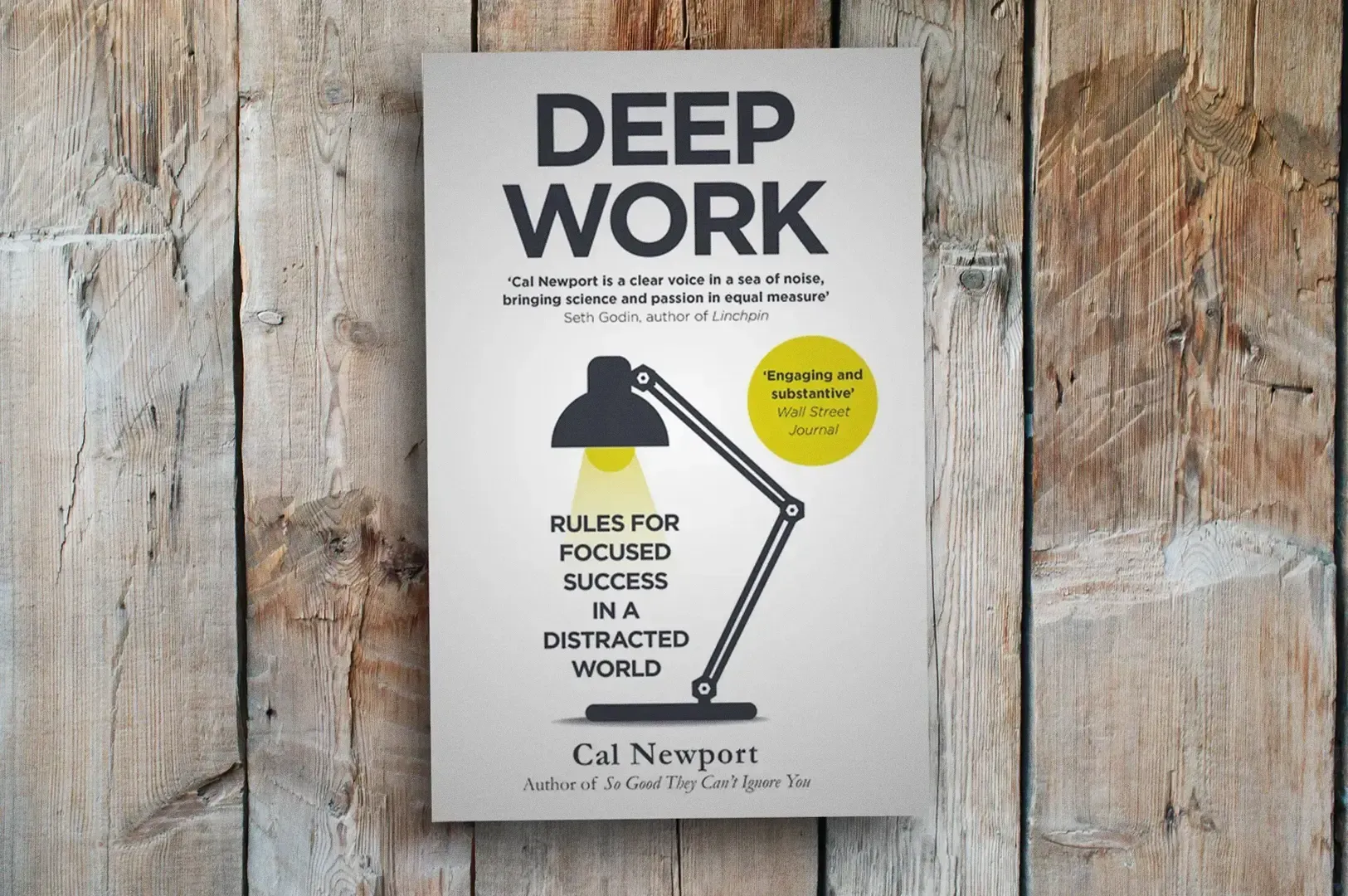



Deep Work by Cal Newport | My Quiet Empire Book Review
In the trenches of building a business, we are often told that success requires constant connectivity. We build open-plan offices, integrate endless messaging channels, and measure our worth by our immediate responsiveness. Yet, the lived experience of scaling an enterprise reveals a very different truth. True competitive advantage does not come from answering emails faster; it comes from the quiet, disciplined ability to solve complex problems. Focus is not a mere productivity hack. It is a structural asset shaped by the systems we build and the noise we deliberately choose to ignore. This is exactly what Cal Newport explores in Deep Work: Rules for Focused Success in a Distracted World.
Newport draws a sharp, necessary distinction between shallow work (the logistical, easily replicable tasks we perform while distracted) and deep work. He defines the latter as professional activities performed in a state of distraction-free concentration that push our cognitive capabilities to their absolute limit. As I reflect on the standards that actually grow a company and shape its culture, it is clear that deep work is where the true economic value is created. Everything else is simply maintenance.

What makes Newport’s framework so compelling is his insistence that focus requires active training, not just good intentions. One line in particular has fundamentally changed how I structure my days: "To simply wait and be bored has become a novel experience in modern life, but from the perspective of concentration training, it’s incredibly valuable." We cannot expect to sustain deep concentration if we spend every minor moment of friction escaping into a screen. Newport argues that embracing boredom and building strict practical rituals are the necessary costs of protecting our attention.
As an author, Newport excels at crisp definitions. He blends rigorous academic research with highly practical arguments, cleanly structuring the book to move from a cultural diagnosis of our distracted economy to a tangible manual for disciplined practice. He writes with the precision of a computer scientist, which makes his thesis both accessible and intellectually urgent.

There is, however, an honest limitation to his framework. Newport’s philosophy often feels highly individualistic, assuming a level of professional autonomy that many people simply do not possess. When you are managing a highly collaborative team, dealing with sudden operational crises, or balancing caregiving responsibilities, retreating to a quiet room to think is rarely a viable option. The book occasionally simplifies the inherent messiness of modern collaboration, where so-called shallow work is sometimes the vital connective tissue that holds a human team together.
Despite this tension, this text is essential for founders, operators, and creators who feel hollowed out by the shallow demands of the digital age. It offers a clear, demanding blueprint for reclaiming your cognitive capacity. It leaves us to wrestle with an uncomfortable, lingering question: If the ability to concentrate deeply is becoming increasingly rare and uniquely valuable, what are we willing to systematically ignore in order to cultivate it?