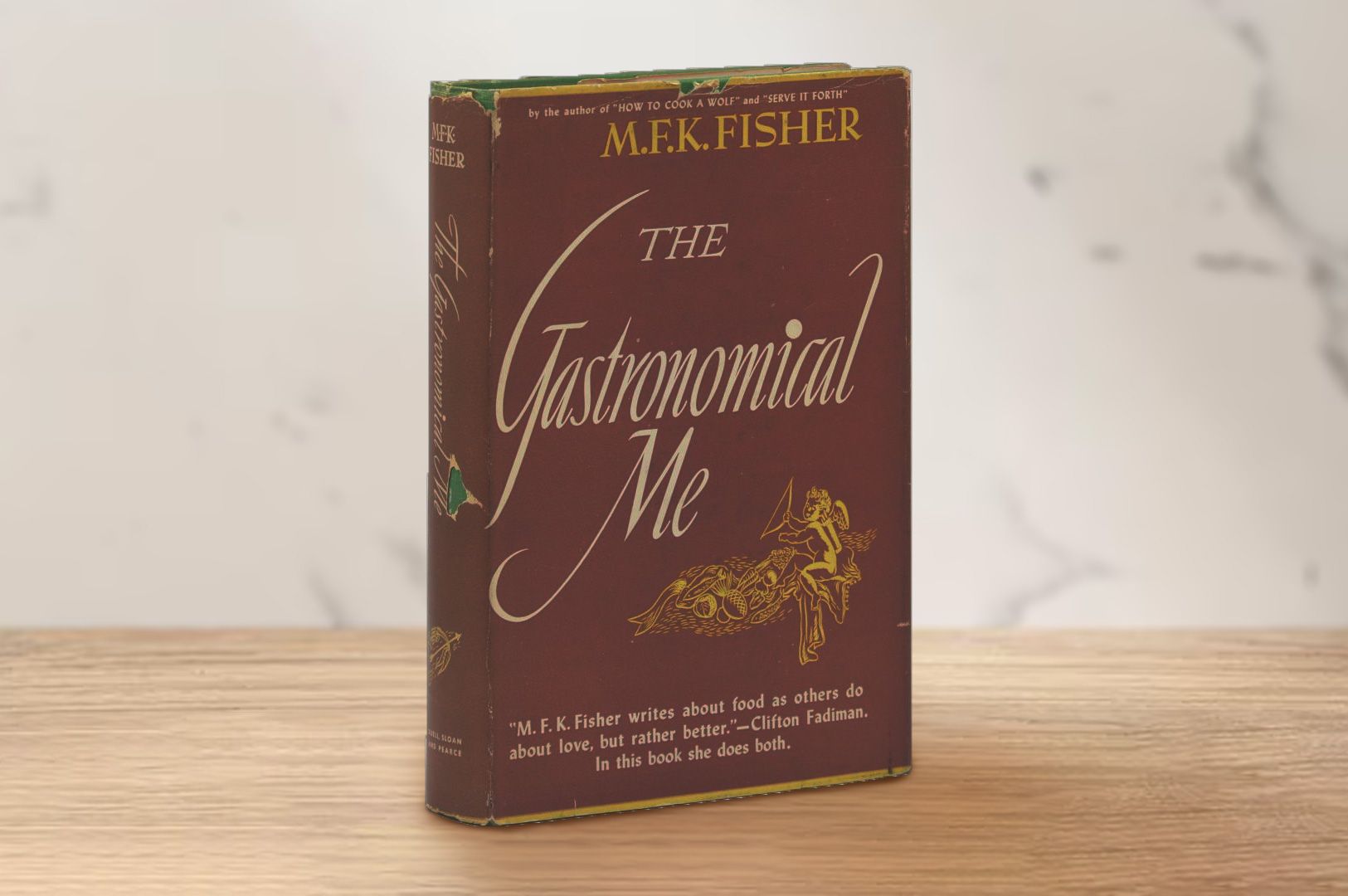



The Gastronomical Me by M.F.K. Fisher | My Quiet Empire Book Review
There is a moment in The Gastronomical Me where M.F.K. Fisher describes eating a tangerine. She does not simply peel and eat it; she warms it on a radiator, carries it to a snowy windowsill, and consumes it sections at a time, noting the exact interplay of heat, cold, sweet, and acid. In her hands, a piece of fruit becomes an event. This is the enduring power of Fisher’s 1943 memoir: it is a testament to the belief that how we eat is inseparable from how we live.
Fisher, often called the godmother of modern food writing, did not write cookbooks. She wrote about the architecture of a life, using hunger as her blueprint. The Gastronomical Me traces her evolution from a child in California to a young woman in Dijon, France, and eventually through the darkening years of pre-war Europe. The book is structured as a series of meals, but these are not restaurant reviews. They are anchors in time. A simple omelet becomes a marker of a failing marriage; a perfectly roasted chicken signifies a moment of fleeting peace. Fisher understands that we construct meaning through sensory experience, and that memory is often flavored before it is spoken.

Her prose is distinct: sharp, unsentimental, and occasionally devastating. She elevates the ordinary acts of shopping, cooking, and eating into something essential, almost sacred. She rejects the idea that food is merely fuel or, worse, a frivolous indulgence. In her famous introduction, she writes: "It seems to me that our three basic needs, for food and security and love, are so mixed and mingled and entwined that we cannot straightly think of one without the others." This passage captures her central philosophy: hunger is never just physical. It is existential. To deny one’s appetite is to deny one’s humanity.

In our current era, which often oscillates between mindless consumption and rigid asceticism, Fisher’s voice feels radical. She challenges the modern tendency to separate pleasure from discipline. For Fisher, true pleasure requires discipline: the discipline of attention. It requires the patience to select the right ingredients, the care to prepare them simply, and the presence of mind to truly taste them. This is not hedonism; it is a form of craft. It connects deeply to the philosophy of mastery we explore in other domains (whether in business or art) where the quality of the output depends entirely on the quality of attention paid to the process.
The Gastronomical Me is not a comforting book in the conventional sense. It is shadowed by loss, war, and the complexities of adult love. Fisher does not shy away from the bitterness that often accompanies the sweet. But this honesty is precisely what makes it valuable. It reminds us that a life of quality is not a life without pain, but a life where we remain awake to it all. It is a meditation on the quiet, daily craft of sustaining ourselves, urging us to treat our own hunger with the dignity it deserves.