Solitude: The Architecture of the Inner Life

Bay San

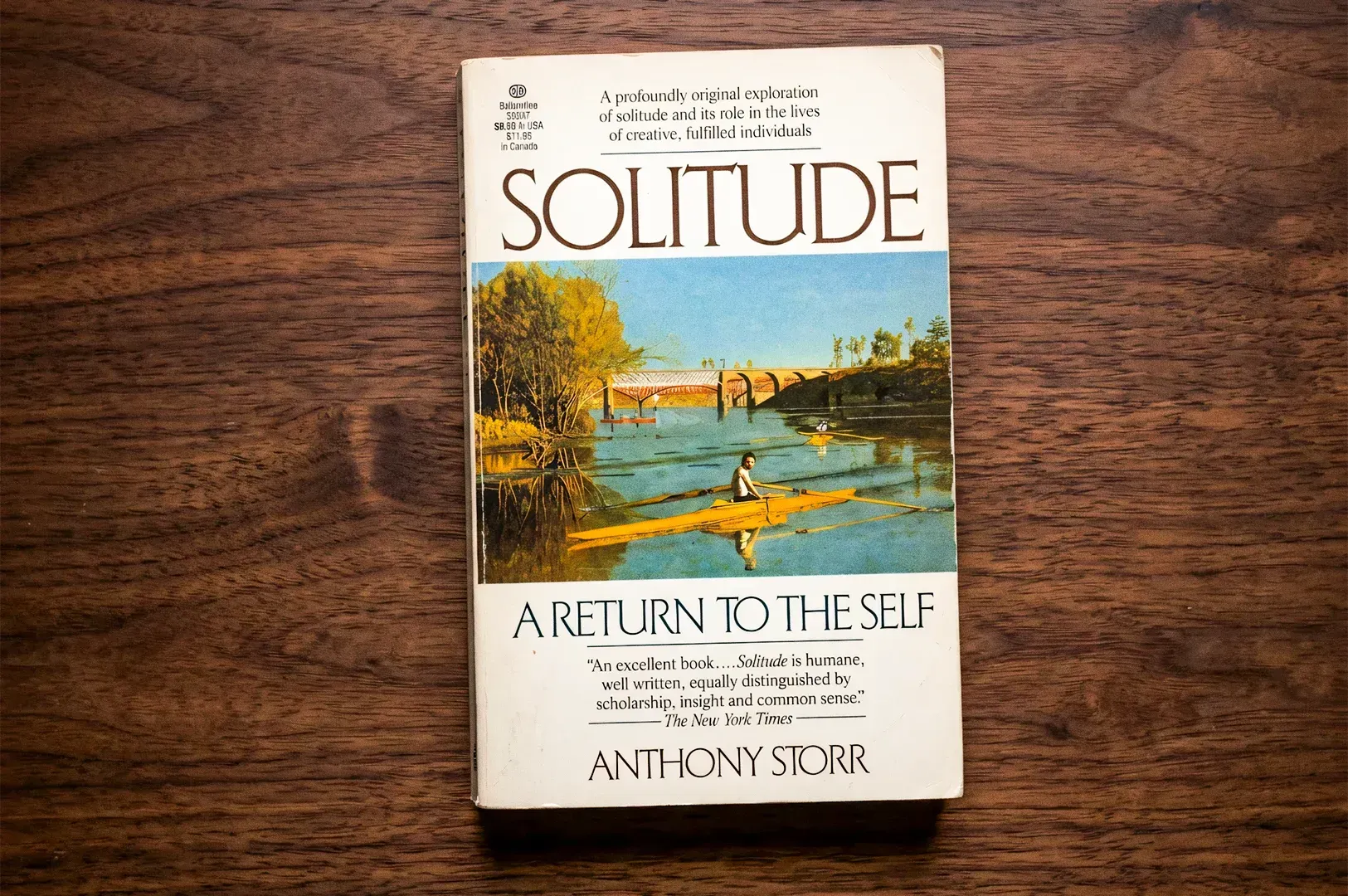
We are rarely taught how to be alone. Modern culture often frames solitude as a deficit or, at best, a temporary waystation between social engagements. Anthony Storr’s Solitude: A Return to the Self is a gentle but insistent argument that solitude is not deprivation, but psychological necessity; a rich condition that underpins creativity, self-realization, and the formation of a private standard when the world is noisy.

Storr’s most enduring insight is that the mature capacity to be alone is essential to both emotional stability and generative thinking. He challenges the dominant belief that relational connection is the sole route to happiness, writing, “The capacity to be alone is a valuable resource for learning, thinking, innovation, and for maintaining contact with one’s own inner world.” In Storr’s view, solitude is not a sign of social failure but a practiced skill that makes possible any lasting creative work or courageous decision.

Low-angle shot of an isolated lighthouse in dense fog with birds, symbolizing solitude vs loneliness, inner clarity, and navigating through mental distraction

His distinction between chosen solitude and imposed loneliness is especially relevant. Loneliness is inflicted from the outside, leaving the individual restless and unanchored. Chosen solitude, on the other hand, is the deliberate act of tuning out the world’s static and listening for the signal of the self. I have seen the wisdom of this directly in business, where long-range decisions demand time in unbroken quiet more than any brainstorm or endless meeting ever could.

In my own experience building different ventures, periods of withdrawal have been essential; not only to protecting judgment, but to deepening craft. When expanding the academy or reimagining a hospitality space, I have learned that stepping back from the din of input is often what prevents the most reactive mistakes. Several high-stakes choices have only become clear after shutting a door, switching off the notifications, and sitting in discomfort until the logic of the right path emerged. In such solitude, you measure your standards against yourself, not the ever-changing demands and judgments of the crowd.

Overhead bird’s-eye view of a person working alone at a multi-monitor desk in a dark room, illustrating deep work, focus, and the modern struggle with digital distraction and solitude

Of course, reading Storr now, some of his framing feels incomplete. The book carries a clinical optimism, possibly underestimating just how aggressively our current environment works against true solitude. Storr could not have foreseen the digital arms race for our attention where being alone with one’s thoughts is an act of defiance rather than a default state. Today, solitude is not simply granted; it must be consciously defended from the persistent distractions and demands of a monetized attention economy. The modern reader may wish for more on how to construct boundaries and create sanctuaries for undistracted time.

Still, Solitude remains a relevant and steadying book, especially for builders, creators, and anyone seeking the quiet authority that only inwardness can provide. It is for those rebuilding identity after transition, for leaders making unsung decisions, or for anyone curious about a deeper, more honest relationship with their inner world.

The lingering question Storr plants is subtle but piercing: In a culture allergic to quiet, if we never devote time to our private selves, how much of what we think or make is truly our own?

More Book Reviews

Flat lay overhead shot of “A Life Less Throwaway” by Tara Button on a white wooden surface, minimali
By Bay San May 22, 2026
Meta Description: Tara Button argues for repair over replace. A reflection on durability as discipline, and what it means to build a life that lasts.
Top-down flat lay shot of
By Bay San May 15, 2026
Discover how James Kerr's Legacy reveals the uncompromising principles behind enduring culture, proving that standards and humility always outlast hype.
Wall‑mounted copy of “The Great Good Place” by Ray Oldenburg displayed against a minimalist white wa
By Bay San May 8, 2026
Culture is engineered, not declared. Discover how Ray Oldenburg’s exploration of third places shapes our understanding of community, belonging, and business.
Straight-on eye-level shot of the book cover “Deep Work” by Cal Newport, showing minimalist typograp
By Bay San May 1, 2026
Focus is not a productivity hack; it is a structural advantage. Discover how Cal Newport’s rules for deep work shape business, craft, and quiet mastery.
Front-facing, eye-level shot of the book cover “The Power of Character in Leadership” by Dr. Myles M
By Bay San April 24, 2026
Character is built through daily choices, not corporate slogans. Discover how Myles Munroe' exploration of moral life shapes enduring business culture.
Overhead top‑down shot of the book Shop Class as Soulcraft: An Inquiry into the Value of Work by Mat
By Bay San April 17, 2026
Manual competence offers a profound form of freedom. Discover how Crawford’s meditation on skilled work shapes our approach to business, craft, and character.
Straight-on product shot of the book cover “Zen and the Art of Motorcycle Maintenance” by Robert M.
By Bay San April 10, 2026
Quality is not an accident; it is a discipline. Discover how Pirsig's meditation on maintenance shapes our approach to business, craft, and quiet mastery.
Three-quarter angle product shot of The Book of Joy by the Dalai Lama and Desmond Tutu, showing mult
By Bay San April 8, 2026
Joy is not a fleeting emotion but a disciplined practice. Discover how two spiritual leaders offer a framework for resilience in business and life.
Book titled ‘Wabi-Sabi for Artists, Designers, Poets & Philosophers’ on a blue background, featuring
By Bay San March 27, 2026
On embracing imperfection: Leonard Koren's meditation on wabi-sabi offers a framework for creation that honors transience over permanence. A reflection on building with constraint.
Vintage copy of ‘The Gastronomical Me’ by M.F.K. Fisher standing upright on a wooden surface with a
By Bay San March 20, 2026
On appetite as philosophy: Fisher's memoir reveals that how we eat reflects how we live. A meditation on attention, pleasure, and intentional living.
Show More