
A Letter on Boundaries: The Quiet Craft of Self-Respect

Bay San • July 2, 2026

The last guest has left the omakase counter, and the room has returned to itself. A single linen napkin sits folded at the corner, exactly where I leave it each night. The light is low, softened by the grain of wood that still holds the warmth of service like a held breath. My phone rests face down on the counter, and there is a message on it I have decided not to read until morning.

For years, that decision would have felt like a small failure. A delay in responsiveness, a hesitation that needed justification. Tonight it feels different. It feels like respect. Not only for myself, but for the structure of a life that requires silence to remain intact.

I sit with that quiet for a moment longer. Then I begin this letter, not as instruction, but as recognition of something I learned slowly, and often late.


To the Version of Me Who Confused Availability with Care

This is a letter to the version of me who believed that being reachable was a form of love. You answered everything. Every message, every call, every request that arrived at an hour meant for rest. You thought responsiveness was generosity, and that saying no would make you cold, or less worthy of trust.

You did not yet understand that availability, without structure, is not care. It is erosion. You were trying to be reliable, but what you became was porous. Everything passed through you, and very little remained. I am writing now because I have learned otherwise, slowly and at a cost that does not need to be repeated.

Boundaries are not walls built to keep people out. They are the shape of a life you have decided to keep intact. They are not defensive architecture. They are design.

What Boundaries Are, Quietly

A close-up, low-angle shot of a sturdy wooden fence, symbolizing the steady, reliable nature of setting firm personal boundaries.

A boundary is not a speech. It is rarely spoken at all. It lives in small, almost invisible decisions: what you answer immediately and what you let rest until tomorrow, what you decline without elaboration, what you no longer rush toward simply because someone else is moving quickly.

I have learned to trust the quiet version of boundaries more than the performative ones. The loud declaration, the explained refusal, the carefully justified “no” often still leaves room for negotiation. It invites friction. The quiet boundary does not.

An unread message at the end of the day. A blocked hour that does not shift. A request declined without a paragraph of explanation. These are not acts of withdrawal. They are acts of structure. Self-respect does not announce itself. It simply holds.

The truest boundaries are not the ones you defend in argument. They are the ones you maintain without needing to explain them at all.


The Year I Was Always Available

There was a stretch in the early days of the consulting firm when I belonged to everyone. A client would write at midnight, and I would respond within the hour. A request would arrive on a Sunday, and I would treat it as if it belonged to Monday’s urgency. I told myself this was devotion. I told myself the work demanded it.

What actually happened was more subtle. The quality of my thinking thinned. I began to produce speed instead of clarity. The work did not necessarily fail, but it lost depth. I was always responding, never arriving fully. Over time, resentment began to appear in places that used to hold curiosity.

The realization did not arrive dramatically. It came in an ordinary moment when a request crossed a line I had never clearly defined, and I felt the automatic impulse to comply. Then I noticed something simple: the line existed only when it was convenient. A boundary that is conditional is not a boundary. It is a preference disguised as discipline.

That was the moment I stopped negotiating with myself.

Craft, Not Conflict

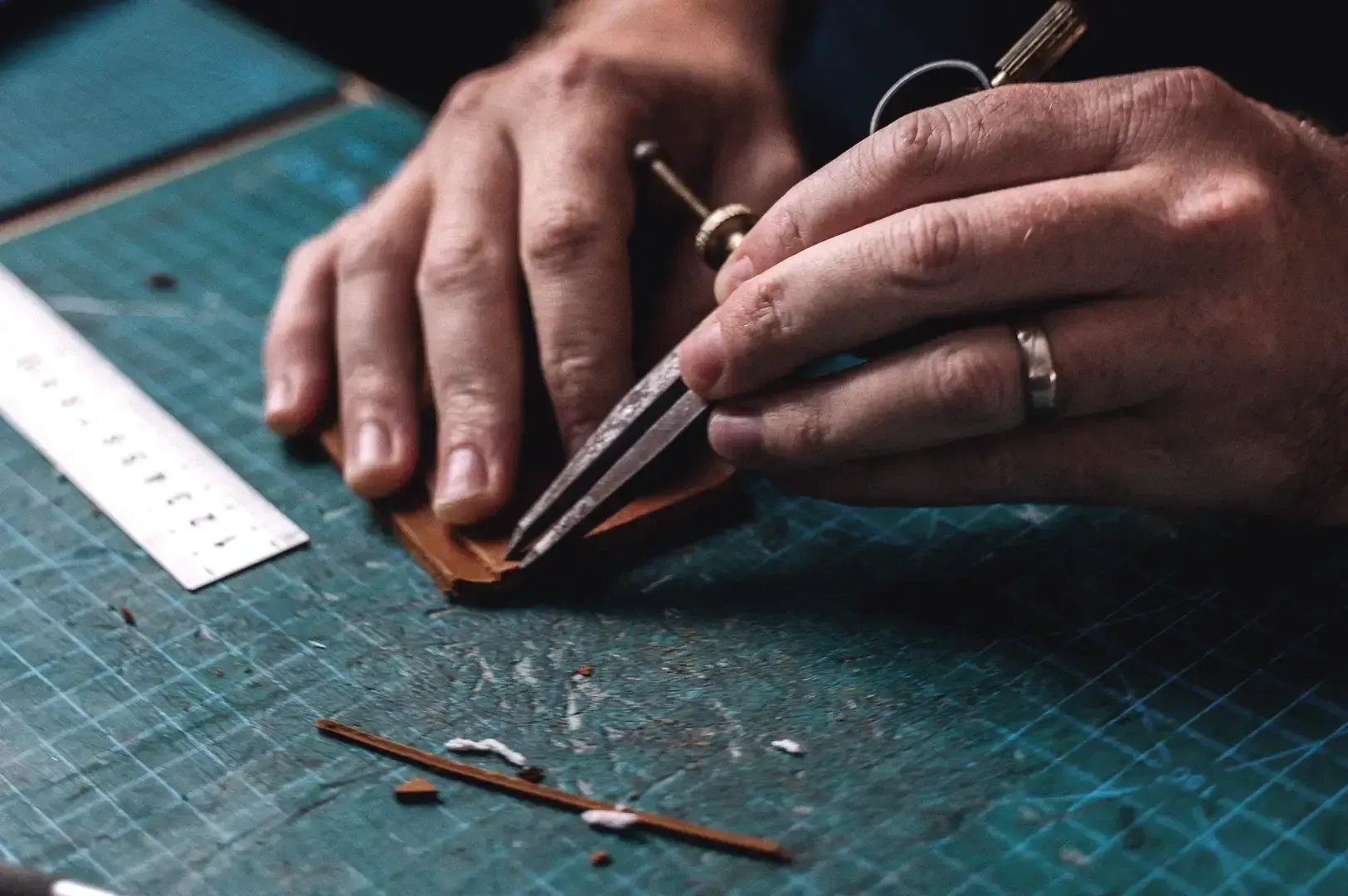
A focused, steady hand using a precision tool to mark consistent holes on a piece of material, illustrating how boundaries are practiced through small, deliberate, and rhythmic actions rather than conflict.

I began to understand boundaries differently when I thought about admissions at the academy. We do not turn people away to assert authority. As I’ve said in “The Inheritance of Standards: What We Leave Behind for the Next Generation, we hold a standard because the standard is what makes the place coherent. Every person admitted changes the environment for everyone else already inside it.

To lower the threshold quietly would not be kindness. It would be dilution. It would be a loss of integrity disguised as openness. The same is true of personal boundaries. They are not acts of rejection. They are acts of preservation.

A boundary enforced once, in reaction, is conflict. A boundary enforced consistently becomes design. People learn its shape the way they learn the grain of a familiar table. Eventually, they stop testing it; not because of fear, but because the structure is legible.

The most mature boundaries do not feel like resistance. They feel like craft.


The No That Protects the Yes

Over time, I learned to keep a small set of rules that hold without exception. I do not engage in work conversations during the hours I have reserved for rest. I do not treat accessibility as obligation simply because technology makes it possible. I do not continue conversations that depend on disrespect. I do not explain myself to people who are not interested in understanding, only in response.

Each of these is a form of preservation. Not of ego, but of attention. The ability to do meaningful work depends on what you refuse as much as what you accept. Without refusal, everything becomes equally urgent, and nothing becomes truly important.

These boundaries are not spoken with heat. They are not performances of control. They are quiet continuities. What remains when you stop trying to convince anyone.

What Stays After You Stop Negotiating

A quiet bedside table with a tablet, charging cords, and a cup of pens, depicting the maintenance of personal space and energy as a consistent, daily habit of self-respect.

The linen napkin is still folded at the corner of the counter. The room is still quiet. The message on my phone will remain unread until morning, and nothing essential will be lost in the delay.

What I have learned is that self-respect is not something you declare. It is something you practice in private, repeatedly, in decisions no one sees. The world does not usually witness the moment you choose not to respond, not to explain, not to overextend. But it feels the result of those choices.

People meet you differently when your edges are intact. Not harder, not colder… simply clearer. The version of you that arrives in each room becomes steadier, not because you are performing discipline, but because you are no longer leaking attention in every direction.

That is the quiet craft. It is built alone, in the empty room, after the guests have gone. And then it is carried forward into every room that follows.

So this is my vow, written not as instruction but as remembrance: I will keep the line gently, and I will keep it every time.

Recent Posts

A focused chef working in a quiet, warmly lit kitchen, symbolizing the pursuit of mastery and how su
By Bay San July 16, 2026
A reflection on how the people we keep quietly calibrate our standards, and why the right company tunes a life rather than filling it.
The book cover of
By Bay San July 15, 2026
Roman Krznaric reframes legacy as cathedral time: building for people you will never meet, and the quiet discipline of the long view.
A minimalist, warm-toned close-up of a simple ceramic tea cup on a table, symbolizing the quiet beau
By Bay San July 14, 2026
A reflection on how imperfection reveals the real, and why the human traces in craft and work are the quiet evidence of authenticity.
A notebook and pen resting on a dark desk, symbolizing the reflective and intentional planning requi
By Bay San July 9, 2026
A quiet letter to young founders on speed, standards, and the slow work of building something worth keeping at the beginning of the journey.
A close-up view of a refrigerated seafood display at a traditional market, showcasing the careful pr
By Bay San July 8, 2026
Market vendors are quiet custodians of craft and culture. A reflection on how their small, repeated choices teach a kind of global literacy.
A close-up, high-angle shot of the book A Field Guide to Getting Lost by Rebecca Solnit, centered on
By Bay San July 3, 2026
Rebecca Solnit reframes getting lost as a discipline: a return to humility, attention, and the kind of not-knowing that remakes you.
A serene, sunlit home studio corner featuring a wooden bookshelf, a cozy chair, and a large window l
By Bay San June 30, 2026
A reflection on how structured morning rituals create the conditions for deep creative work, attention, and clarity before the world enters.
A copy of 'On Dialogue' by David Bohm resting on a dark surface, representing the foundational conce
By Bay San June 25, 2026
Why genuine dialogue is rare: a reflection on Bohm's idea of thinking together, suspension, and what real listening demands of leaders and teams.
A chef working in a warm, dimly lit restaurant kitchen, symbolizing the quiet dedication and profess
By Bay San June 25, 2026
A reflection on how standards become a quiet inheritance, passed down through care, training, and craft long after the founder leaves the room.
A candid photo of a person walking past a bakery window display, illustrating how slow, intentional
By Bay San June 23, 2026
A reflection on walking as inquiry, and what a city offers when you move slowly enough to be interrupted by it.
Show More