
Tools as Teachers: What Our Instruments Reveal About Practice
The whetstone is wet, and the sound it makes is patient.
Before service at the omakase restaurant, I draw the blade across the stone in long, even passes. The slurry thickens into a pale grey paste. There is a smell to it, mineral and cold, closer to river than kitchen.
The room is empty. No guests, no music, only the soft drag of steel on stone, again and again, until the edge is not sharp enough to pass but right.
I have learned to trust that hour more than almost any other. The stone does not flatter me. It simply tells me, honestly, what my hand has been doing.
The Tool That Corrects You
A blade will not lie to you. Sharpen it carelessly, with more pressure on one side than the other, and the edge comes back uneven. You feel it later, in the first cut, when the knife wanders where you did not ask it to go. The tool has recorded your impatience and handed it back.
I remember a night, early on, when I rushed the sharpening because the doors were about to open. I told myself it was good enough. The fish told me otherwise. The slices came ragged at the edge, and no one at the counter said a word, but I knew. The knife had exposed something I did not want to see about myself that evening.
There is a difference between using a tool and submitting to it.
Using it, you bend it toward your will, quickly, on your terms. Submitting to it, you let it set the terms. You slow to its pace. You accept its correction.
The stone taught me that most of my mistakes were not mistakes of skill.
They were
mistakes of hurry.
Practice Has a Texture
Practice is not a feeling. It is a set of small, physical acts, done whether you feel like doing them or not.
At the tea room, before anyone arrives, there is cleaning. Not the dramatic kind. The quiet kind. Wiping down surfaces that were already clean. Wiping them again. Setting the whisk to dry in the same spot it always dries.
The hands learn things the mind forgets. The particular weight of a clean cloth, damp but not wet. The sound a cup makes when it is set down correctly, a small precise note rather than a clatter.
I will not pretend this is always peaceful. Some mornings the repetition is simply dull. The stone is cold. The cloth is cold. You would rather be anywhere else.
But the dullness is part of it. Preparation has a dignity precisely because it asks nothing back. No one applauds the hour before. You do it because the thing after depends on it, and because a standard kept only when watched is not a standard at all.
A Business Lesson: Standards vs. Convenience
Across every venture, I have learned to separate two kinds of things. The ones worth preserving, and the ones allowed to move.
The training holds. The rituals of preparation hold. The threshold below which the work is simply not sent out holds. These are the essence, and to let them drift is a quiet betrayal of everyone who trusted the place.
Almost everything else can change. The format. The menu. The location. The tools themselves, the systems, the way information moves through a company. These are surfaces, and surfaces are meant to shift with the decade.
Here is where a good tool earns its place. A tool enforces a standard that words cannot. At the consulting firm, a checklist did more to protect our quality than any speech I ever gave about caring. The speech could be nodded at and forgotten. The checklist had to be done.
A scale exposes the cook who was guessing. A checklist exposes the team that was hoping. The tool makes the claimed standard prove itself, or reveals that it was only ever claimed.
Convenience always argues well in the moment. The tool does not argue. It just shows you, plainly, where you cut the corner.
Instruments Reveal the Maker

There is a temptation I know well. When the work is hard, buy a better tool. A finer knife. A newer system. A more elegant framework. The purchase feels like progress, and for a while it quiets the discomfort of not yet being good enough.
But the better tool rarely fixes the thing. I have watched people acquire beautiful equipment and use it exactly as carelessly as they used the old. The instrument changed. The habit did not.
The quiet confidence I have come to admire looks unadorned. A cook with one worn knife, used properly, will always move me more than a drawer of untouched steel. Mastery tends to strip away rather than accumulate. It has stopped needing to prove anything.
Consider two instruments from two worlds. A chef's knife and an architectural drafting square.
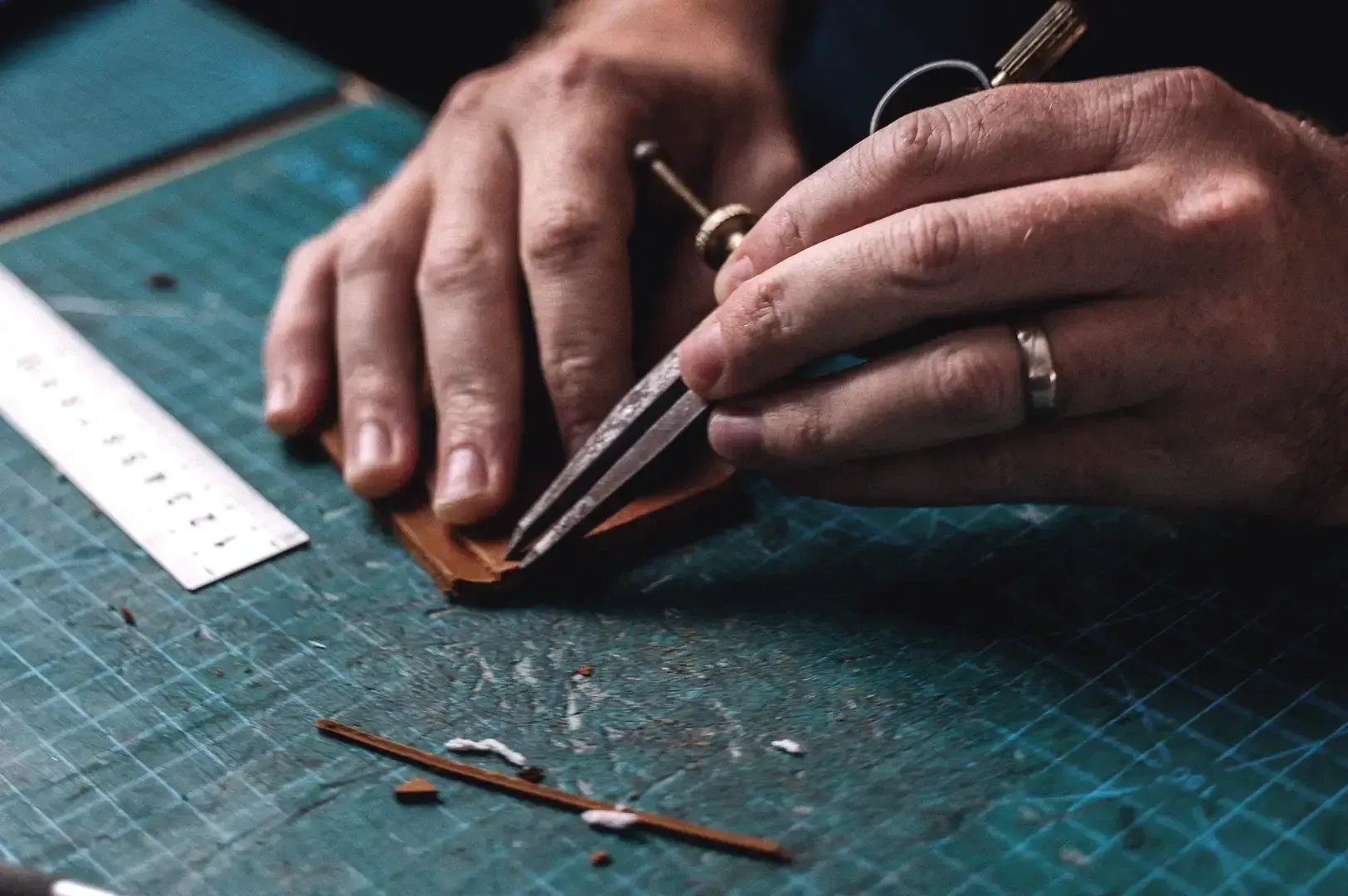
The knife teaches attention to the single moment, the one cut you cannot take back. The square teaches attention to the whole, the line that must be true before anything can be built upon it. One asks for presence. The other asks for foresight. A person who learns both begins to see their work from both ends at once.
I think often of a rubric we built at the academy, in the early years.
We made it to assess the students. What we did not expect was how much it disciplined the teachers. To grade a thing honestly, an instructor first had to know, precisely, what good looked like. The rubric forced that clarity. It trained the teacher as much as the student, and the better teachers admitted this freely.
The tool you build to measure others will, if you are honest, measure you first.
Closing Reflection
The knife is sharp now. The stone goes back in its place, wiped and dry, waiting for tomorrow.
We become, slowly, the things we reach for each day. The stone made me patient because impatience showed up in the edge. The checklist made me honest because hoping showed up in the gaps. I did not choose these lessons. The tools taught them, quietly, through use.
That is the maxim I have kept, understated and earned: a tool does not lie, so choose carefully what you pick up each morning.
The room is still empty.
In an hour the first guest will arrive and know none of this, and that is exactly as it should be.