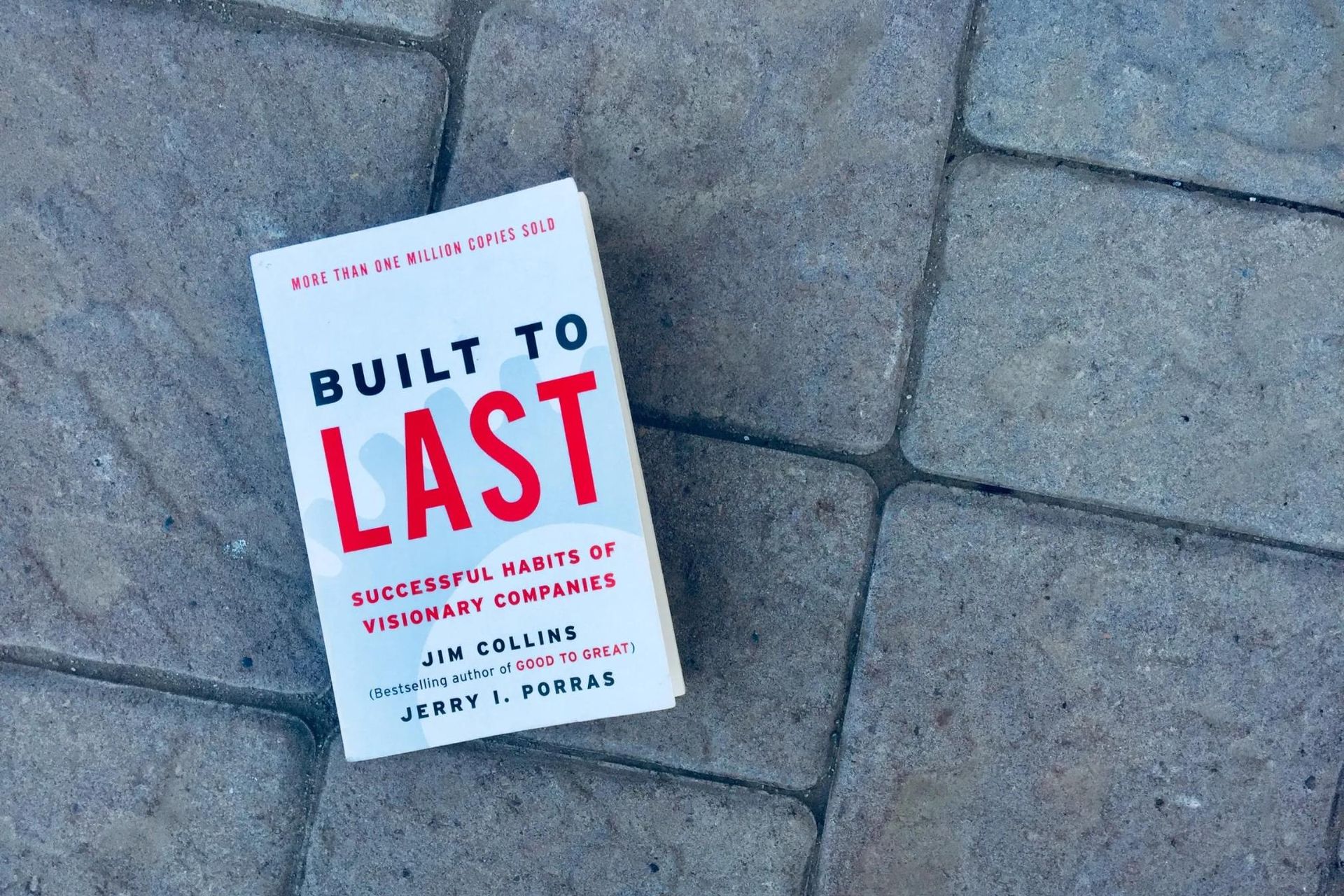



Built to Last by James C. Collins and Jerry I. Porras | My Quiet Empire Book Review

Jerry I. Porras & James C. Collins

In a business landscape obsessed with the “next big thing” and the allure of the quick exit, Built to Last stands as a defiant monument to the idea of permanence. James C. Collins and Jerry I. Porras invite us to consider what lies beneath the surface of visionary companies; those rare institutions that not only succeed over time but shape their industries and endure well beyond the tenure of any individual leader. In doing so, they challenge the dominant narrative that lasting greatness comes from charismatic founders, lucky product launches, or flashes of genius. Instead, they reveal that endurance is born from the deliberate architectural design of an organization’s culture, values, and capacity to evolve.


The book’s brilliance stems from its comparative research methodology. Collins and Porras select pairs of companies, one “visionary” (like Marriott, 3M, or Hewlett-Packard), one merely “successful” (Howard Johnson, Norton, Texas Instruments), and study them side by side across decades. Through this lens, patterns invisible in traditional case studies come into focus. The most powerful of these is the distinction between a company’s “core ideology” and its operational practices. Visionary companies, they show, protect their core values and purpose with almost sacred rigor while remaining highly flexible and adaptive in all other matters.

A distinguished older man with a grey beard and dark suit stands holding a massive, heavy stack of paper files. The setting appears to be a modern office, with a wooden desk, laptop, and plant-filled shelving unit visible in the background.

This distinction is more than academic. In my own experience building institutions; whether an academy, consulting firm, or dining concept, an unwavering core ideology has proven to be the anchor in turbulent times. Our academy’s founding principle, transforming perspective through education, has never changed. Yet how we realize it (our curriculum, our delivery, our use of technology) evolves with each generation of faculty and learner. Collins and Porras argue that this dance between stability and change is what enables an organization not just to survive but to thrive across eras.


Their idea of “preserve the core, stimulate progress” is particularly resonant for anyone who has felt the pull between honoring foundational values and adapting to new realities. The book details how enduring companies institutionalize their philosophies through rituals, internal jargon, and distinct cultures. The concept of “Big Hairy Audacious Goals” (BHAGs), daring missions that galvanize an entire workforce, emerges not as managerial hype but as a tool for aligning ambition with identity.


Still, Built to Last has its limits. The principles distilled here are drawn from large, established corporations, not tiny startups or solo ventures. The “cult-like cultures” the authors admire can sound exclusionary or even intimidating for an individual entrepreneur. And the infrastructure of legacy requires time, resources, and, at least in the early days, a leap of faith that can feel abstract to founders focused on survival. The book’s strengths are also its challenges: it offers not a tactical playbook but a philosophical framework, requiring each reader to translate principles into realities suited to their scale and context.

In a bright, modern conference room with floor-to-ceiling windows, a panel of professionals sits around a U-shaped wooden table equipped with microphones. Two senior individuals at the head of the table face the other attendees, appearing to lead a formal hearing or corporate meeting.

Yet therein lies its value. Built to Last is a book about institutional design, not product strategy or personal productivity. It invites reflection rather than prescription. Are you building a time-teller, or are you building a clock? This fundamental question lingers long after the pages are closed. For those invested in legacy: those determined to shape organizations that outlast themselves, it is essential reading. Collins and Porras remind us that visionary companies are not the product of any one person or moment, but of an ongoing discipline that preserves what matters most, and adapts everything else.

More Book Reviews

Minimalist book cover of The Laws of Simplicity by John Maeda displayed on a bright yellow backgroun
By Bay San February 13, 2026
On the power of restraint: Maeda's ten laws reveal that simplicity is not subtraction but strategic clarity. A reflection on doing less, better.
By Robert Macfarlane February 9, 2026
On thinking with your feet: Macfarlane's walking journeys reveal that clarity comes through movement, not stillness. A reflection on embodied wisdom.
A person's hand holds a small, navy blue book titled Silence: In the Age of Noise by Erling Kagge, w
By Erling Kagge February 2, 2026
On finding stillness in noise: Erling Kagge's meditation reveals silence as a cultivated skill, not escape. A reflection on attention and inner discipline.
The image features a close-up, angled view of the book cover for Mastery by George Leonard. It showc
By George Leonard January 23, 2026
On loving the plateau: George Leonard's Mastery reveals that fulfillment comes not from peaks but from patient practice. A meditation on craft and endurance.
This overhead shot displays two books placed on a dark, weathered wooden table, featuring the Englis
By Yanagi Sōetsu January 6, 2026
On beauty without ego: Yanagi's meditation on folk craft reveals how mastery emerges through selfless work, not individual ambition. A reflection on craft and legacy.